Waking up wondering why do I feel so stiff in the mornings? In this article we explore why, and 3 things you can try to improve how you feel in the morning.
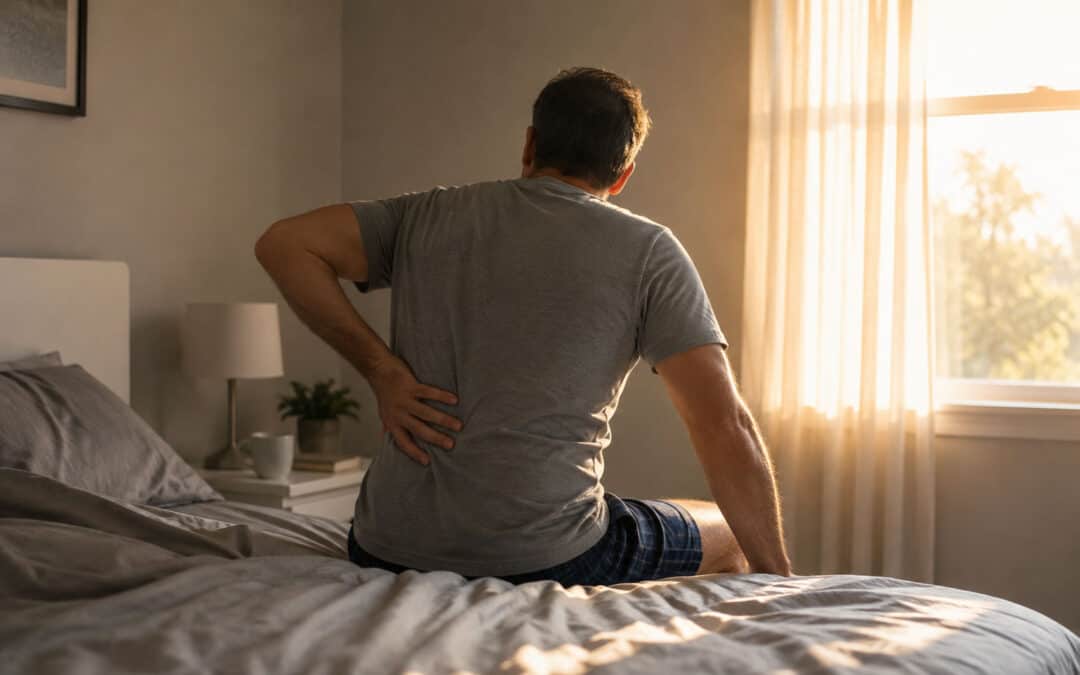
You get out of bed and your back feels like it needs a minute. Your shoulders want a roll. Perhaps those first few steps feel decidedly creakier than the ones you take half an hour later.
Morning stiffness is common, and waking up stiff doesn’t automatically mean there’s something wrong with your body. Stiffness can be more noticeable after you’ve spent a long time relatively still, including overnight, and for many people it starts to ease once they get moving.
But not all morning stiffness is the same. How long yours lasts, whether movement changes it and whether you have pain or other symptoms alongside it can all be useful clues. And before you automatically reach for a big stretch, there are three things we’d suggest trying.
Why do I feel stiff in the morning?
There isn’t one single cause of morning stiffness. One simple part of the picture is that you’ve spent several hours relatively still. We can also feel stiff after other periods of inactivity, such as getting up after sitting for a long time.
But the night itself isn’t necessarily the whole story. Your body arrives in bed after an entire day of sitting, walking, exercising, driving, carrying children, gardening, working or perhaps doing very little at all. A sudden increase or decrease in your usual activity, existing muscle or joint symptoms, sleep and other factors may all influence how you feel the following morning.
So before blaming your mattress, ask another question…
What did yesterday look like?
A morning after eight hours at a desk may feel different from one after a long walk or an unusually strenuous gym session. That doesn’t mean yesterday’s activity caused your stiffness. It simply means morning stiffness is worth looking at in context.
Is it normal to feel stiff in the morning?
An occasional stiff or creaky start to the day that settles as you begin moving is not automatically a sign that something is damaged. And this is important: feeling stiff and actually having lost flexibility aren’t necessarily the same thing. “Stiffness” is a sensation. We can feel tight, restricted or reluctant to move without that automatically telling us that a particular muscle has become too short and needs to be stretched.
That’s one reason we wouldn’t immediately attack the tightest area with the biggest stretch we can manage.
Instead, see what happens when you start moving. Please don’t take morning stiffness as a sign you’re ‘broken’ or need immediate help.
Why do I loosen up once I start moving?
If you’re stiff getting out of bed but barely notice it by the time you’ve showered, dressed and made breakfast, you’re not imagining the change. Stiffness after rest can ease with movement, which is why NHS musculoskeletal guidance encourages people experiencing back stiffness to keep moving and stay active.
The way your stiffness responds gives you useful information. If comfortable movement helps it settle fairly quickly, that’s a very different pattern from stiffness that lasts for hours, is becoming progressively worse or comes with swollen joints or significant pain. So rather than judging your body in the first 30 seconds of the day, give it a chance to wake up first.
Is my mattress causing my morning stiffness?
Possibly, but don’t convict the mattress too quickly.
If you’re uncomfortable in bed, regularly waking because of pain, or your symptoms noticeably changed after changing your mattress or sleeping arrangements, that’s worth considering.
But waking up stiff doesn’t automatically mean you need to buy a new mattress or pillow.
Look at the whole picture: what you did the day before, where you feel stiff, how frequently it happens and, importantly, what happens once you’re moving.
Does morning stiffness mean I need to stretch?
Not necessarily. Stretching isn’t bad, and you may enjoy it. But feeling stiff doesn’t automatically mean a muscle needs to be stretched longer. Think about what many of us do with a stiff back. We immediately bend forward to see how far we can reach. With a stiff neck, we turn until we find the restricted bit.
Essentially, our first movement of the day becomes a test… “Am I still stiff?”
So tomorrow morning, try something different…
3 things to try tomorrow morning
1. Start smaller
Rather than immediately testing the movement that feels most restricted, start with small, comfortable movements.
Let the movement gradually become bigger if it feels comfortable.
You’re not trying to achieve a stretch. You’re simply giving your body a chance to start moving again.
2. Get up and get on with your morning
Walk downstairs or around a room or garden. Open the curtains. Make your tea. Let the dog out.
After two or three minutes of ordinary movement, check again.
Has anything changed? If the answer is yes, that’s worth noticing.
3. Look for a pattern, not a diagnosis
This is perhaps the most useful thing you can do. For the next seven mornings, pay attention to four things:
1. Where do you feel stiff?
2. Roughly how long does the stiffness last?
3. Does ordinary movement make it better, worse or make no noticeable difference?
4. Was yesterday different from usual?
You don’t need a complicated symptom diary. A quick note on your phone is enough. At the end of the week, look back at the whole picture rather than judging each morning individually.
You may start to notice something you hadn’t spotted before.
Look at yesterday, not just last night. When we wake up stiff, it’s easy to immediately blame the night’s sleep, for example the mattress, the pillow, the position we sleep in.
Those things may be relevant, but your body didn’t suddenly appear when you went to bed. Think about the previous day too. Did you spend eight hours at your desk? Did you have a particularly inactive Sunday? Were you gardening for most of the afternoon? Did you drive for several hours? Did you do a harder gym session than usual? Were you carrying children, shopping bags or moving furniture?
This doesn’t mean any one of those things caused your morning stiffness. You’re looking for patterns, not trying to diagnose yourself. Perhaps you discover that you’re particularly stiff after an unusually inactive day. Maybe it’s more noticeable the morning after certain activities. Perhaps it normally disappears once you’ve showered and walked around. Or perhaps it’s gradually taking longer to ease.
When should I be more concerned about morning stiffness?
This is where morning stiffness deserves a little more attention.
The NHS advises speaking to a GP if your joints are stiff for more than 30 minutes after waking. Prolonged morning joint stiffness can occur with inflammatory conditions such as rheumatoid arthritis, particularly when accompanied by symptoms such as joint pain, swelling, warmth or tenderness.
That doesn’t mean stiffness lasting 31 minutes means you have arthritis. It means persistent or prolonged stiffness shouldn’t simply be self-diagnosed as tight muscles. It’s also sensible to seek advice if your symptoms are worsening, repeatedly affecting your normal activities or sleep, or you’re otherwise concerned about them. If you’re not sure what is best, our helpful reception team would be happy to advise you.
What if it’s my back that’s stiff every morning?
Back stiffness after resting is common. If it settles as you start moving and isn’t significantly affecting you, keeping active may be all you need. But if your back stiffness is accompanied by ongoing or recurring pain, is getting worse, affecting your sleep or activities, or simply isn’t settling, it’s worth getting advice rather than endlessly trying different stretches.
You can also read our guide to ongoing and recurring lower back pain.
Could stress be contributing to how stiff you feel?
It’s also worth thinking beyond what you’ve physically done.
Stress can show up physically too. The NHS lists muscle tension or pain as one of the physical symptoms of stress, and stress can also affect how well we sleep.
That doesn’t mean stress is necessarily causing your morning stiffness, or that what you’re feeling is “all in your head”. But if you’ve had a particularly stressful week, you’re sleeping poorly, your shoulders have been permanently up around your ears and you’re feeling more tense than usual, it’s worth considering that as part of the picture too.
So when you’re thinking about yesterday, don’t only ask: Did I sit too much or exercise more than usual?”. You could also ask: “How was I feeling?”
Our physical and mental wellbeing aren’t completely separate. Sometimes understanding what’s happening means looking at both.
Read NHS advice about stress and its physical symptoms
The bit we’d like you to remember
Your body isn’t necessarily broken because it feels stiff when you first get out of bed.
Give it a chance to move before deciding something needs fixing.
And if morning stiffness is becoming a regular feature of your day, don’t just keep stretching the same spot and hoping for the best.
Pay attention to the pattern. Some sort of journal can be really useful to monitor all areas of your wellbeing.
If you need some help understanding that pattern, a physiotherapy assessment can look at your symptoms, movement, activity and individual circumstances rather than simply treating whichever bit happens to feel stiff.
At Body Reset Clinic in Hartley Wintney, that’s exactly what we’re interested in. Helping you understand what’s happening and what you can do about it.
If you’re asking what is the best treatment for chronic lower back pain, the honest answer is that it depends on what’s actually driving your pain, and most people never get that question properly answered. If you’ve had lower back pain for months, you’ve probably already tried the obvious things: rest, over-the-counter anti-inflammatories, a few YouTube stretches, maybe a heat pack on the sofa. And yet here you are, still dealing with it. That experience is more common than you might think. The reason those approaches rarely work isn’t that they’re completely wrong, it’s that they target the symptom rather than whatever is actually driving the pain in the first place.
QUICK ANSWER
The best treatment for chronic lower back pain usually isn’t one single treatment. Current evidence recommends a combination of exercise, physiotherapy, education and active self management. For some people, sports massage, acupuncture or cognitive behavioural therapy may also help, depending on what’s contributing to their pain. The most important step is identifying the underlying cause so treatment can be tailored to you.
For most people, treatment includes:
A thorough physiotherapy assessment
A personalised exercise programme
Staying active rather than prolonged rest
Education about managing pain
Sports massage where muscle tension limits movement
Additional treatments such as CBT or acupuncture when appropriate
Chronic lower back pain rarely has a single, tidy cause. The most effective treatment approach reflects that complexity. At Body Reset Clinic, every assessment starts with understanding the root cause of why a client’s back pain keeps returning before any treatment decision is made. That principle is simple: treat the problem, not just the pain. It’s what separates short-term relief from lasting recovery.
This article walks through the evidence-based treatment categories for chronic lower back pain, what to try first, how to layer therapies effectively, and the self-management steps that make recovery stick.
At a glance: Treatment options for chronic lower back pain
Physiotherapy
Best for identifying the underlying cause of pain and creating a personalised rehabilitation plan.
Exercise
The strongest evidence supports regular, progressive exercise to reduce pain and improve function over the long term.
Sports massage
Can help reduce muscle tension and improve movement, particularly when combined with rehabilitation.
Acupuncture
May provide additional pain relief for some people and is often most effective alongside active treatment.
CBT
Can be beneficial if persistent pain is affecting confidence, sleep or fear of movement.
Steroid injections
Usually only recommended for specific nerve-related conditions rather than general lower back pain.
Surgery
Reserved for a small number of people with serious structural or neurological conditions.
_____________________________
Why does chronic lower back pain keep coming back?
Most people manage back pain reactively. They take anti-inflammatories when it flares, rest until it settles, then return to exactly the same habits that aggravated it in the first place. The pain returns because the underlying dysfunction never gets addressed, whether that’s weak stabilising muscles, restricted hip mobility, or poor movement mechanics through everyday tasks. Sitting, lifting, walking: if the mechanics are off, the load keeps falling in the wrong place.
There’s also a neurological dimension that’s easy to overlook. When pain persists over months or years, the nervous system can become sensitised. Pain signals continue even after the original tissue irritation has resolved, because the brain has learned to treat that region as threatening. This is a well-documented physiological process, not a psychological weakness, and it requires a specific clinical response alongside the physical treatment.
Physiotherapy assessment of chronic non-specific lower back pain commonly identifies a cluster of contributing factors: impaired lumbopelvic control, reduced hip and trunk coordination, and core endurance deficits rather than simple muscle “weakness.” Altered movement patterns develop over time as the body protects itself from pain, and these, too, need addressing.
Psychosocial contributors, including poor sleep, elevated stress, and fear-avoidance behaviour, are also legitimate drivers that a thorough clinician will screen for. Chronic lower back pain is almost never one-dimensional.
What is the best treatment for chronic lower back pain? What the evidence says to try first
NICE guideline NG59 is clear on this point. For chronic non-specific lower back pain, the first-line recommendation is exercise, an active self-management approach, and advice to stay active. Bed rest is not recommended. Routine imaging, whether X-ray or MRI, is not recommended for non-specific cases either. The evidence does not support passive, reactive management as a starting point.
A large systematic review found that exercise reduces pain by approximately 15 points on a 100-point scale compared with no treatment, with moderate-certainty evidence, a clinically meaningful improvement.
The important word is “exercise” in its broadest sense. Aerobic activity, resistance training, motor control and stabilisation work, yoga, Pilates, and consistent walking have all shown benefit. No single type is consistently superior to the others. The best exercise for your back is the one you’ll actually do consistently and progress over time. That principle matters more than the specific modality. (See evidence that exercise reduces pain in adults with chronic non-specific low back pain.)
Why is physiotherapy considered one of the best treatments for chronic lower back pain?
There is a meaningful difference between receiving a printed sheet of generic core exercises and undergoing a proper physiotherapy assessment. A thorough assessment evaluates movement quality, identifies the specific structures contributing to pain, screens for psychosocial factors, and builds a programme around your lifestyle, load demands, and goals. That context is what makes a rehabilitation plan effective rather than generic.
At Body Reset Clinic, the starting point is always understanding why each individual’s back pain persists before any treatment tool is selected. This contrasts sharply with the experience many people have of receiving the same exercises regardless of what’s actually driving their symptoms. A plan built around your specific movement faults and contributing factors will consistently outperform one built around a diagnosis label alone.
Progressive loading is a core principle supported by the evidence and widely recommended in clinical guidelines. The exercise plan must increase in demand over time to build genuine capacity in the tissues and neuromuscular system. A programme that stays at the same level indefinitely provides short-term adaptation but plateaus quickly. Progression, guided by tolerance and clinical reasoning rather than fear of pain, is what drives meaningful long-term change.
Physiotherapy also includes education about movement and pacing. People who’ve lived with back pain for months or years often develop compensatory movement habits that maintain their symptoms without realising it. Understanding how you move through everyday tasks, and learning how to change those patterns, is a core part of what makes supervised rehabilitation valuable. While evidence comparing supervised and unsupervised exercise is mixed, supervision typically adds individual assessment, structured progression, and education that self-directed programmes often lack.
How hands-on therapy fills the gaps exercise alone can’t
Even with a well-designed exercise programme, chronically overactive muscles, trigger points, and restricted fascial tissue can limit progress. If the muscles surrounding the hips and lumbar spine are locked in a state of guarding, the body cannot load through the movement patterns the exercise programme is trying to build. This is where sports massage becomes clinically relevant rather than simply relaxing.
Pooled trial data suggest a moderate effect size (SMD approximately 0.75) for sports massage on pain versus inactive controls in chronic low back pain. It’s worth noting that confidence in this evidence is limited, some reviews rate it as low to moderate certainty, and massage works best not as a standalone treatment but as a tool that prepares the soft tissue for more effective rehabilitation. The likely mechanism involves reducing the nervous system’s protective splinting response and improving tissue extensibility enough to allow better quality movement, though the clinical evidence is primarily short-term. For further reading on massage approaches, see this overview of massage therapy for lower back pain.
This is where Body Reset Clinic’s joined-up model makes a practical difference. Rather than seeing a physiotherapist for exercises and a massage therapist separately, with no connection between the two, having both under one roof means the treatment plan is coherent. The sports massage targets the tissue restrictions limiting exercise quality; the physiotherapy builds the strength and movement patterns needed for long-term stability. That combination directly addresses the most common frustration in chronic back pain management: treating the same problem repeatedly without ever resolving it.
CBT, acupuncture, and when injections are appropriate
For a significant proportion of people with chronic lower back pain, psychological factors maintain the pain cycle in ways that physical treatment alone won’t resolve. Fear-avoidance behaviour, sleep disruption, and catastrophising are documented neurological and behavioural responses to persistent pain, not character flaws, and they require their own targeted approach. NICE NG59 recommends considering a combined physical and psychological programme incorporating a cognitive behavioural approach when psychosocial barriers are present, or when earlier treatments haven’t achieved sufficient progress.
CBT has moderate-certainty evidence for long-term pain reduction in chronic non-specific lower back pain. Evidence also suggests that CBT combined with physical therapy can outperform physical therapy alone in the short term, though effect sizes vary across trials. The realistic role of CBT is as a component of a broader treatment programme rather than a replacement for physical rehabilitation. If pain catastrophising, sleep disruption, or fear of movement are features of your experience, raising this with your physiotherapist or GP is a sensible next step.
Acupuncture occupies a useful middle ground. Cochrane review evidence supports acupuncture for medium-term pain relief, roughly three to twelve months, in chronic lower back pain, with moderate-certainty ratings for some outcomes. It works best when used alongside active rehabilitation rather than as a passive standalone treatment. If acupuncture reduces pain enough to allow better quality movement and exercise engagement, it has done its job.
Epidural steroid injections are not appropriate for general non-specific lower back pain. They are indicated for nerve root pathology: lumbar radicular pain (pain radiating along the nerve pathway), disc herniation with nerve compression, or spinal stenosis producing neurogenic symptoms. When those conditions are present and conservative treatment over four to six weeks hasn’t provided sufficient relief, injection can reduce pain for weeks to several months and support engagement with rehabilitation.
Surgery remains a last resort, appropriate when there is persistent or progressive neurological deficit, structural compression confirmed on imaging, or suspected serious pathology such as malignancy or cauda equina compromise (a rare but serious condition affecting the nerve bundle at the base of the spine).
What can you do at home for chronic lower back pain?
The most durable outcomes in chronic lower back pain come from building a consistent movement habit over time, not from any single treatment episode. This doesn’t require a gym membership or a complex programme. Walking, swimming, or home-based strengthening can all deliver meaningful benefit when progressed gradually. The principle of graded activity, starting at a manageable level and increasing load steadily, guided by planned progression rather than moment-to-moment pain levels, is the foundation of long-term self-management.
One of the most common patterns in chronic back pain is what clinicians call the boom-bust cycle: overdoing activity on good days, then collapsing into rest on bad days. Pacing means keeping activity levels more consistent, making decisions about movement based on a planned weekly progression rather than how the back feels on any given morning. This approach reduces the peaks and troughs that maintain sensitisation and disrupts the reactive management pattern that keeps most people stuck.
Sleep quality and stress levels are worth addressing directly as part of recovery. The research on sleep hygiene as a standalone intervention for back pain is limited, but both poor sleep and elevated stress are known to lower pain thresholds and slow tissue recovery. Managing these factors won’t replace physical rehabilitation, but ignoring them creates an uphill environment for recovery.
Where to start if you’re ready to address this properly
The best treatment for chronic lower back pain isn’t one intervention. It’s a coherent approach that identifies what’s actually driving your pain and builds a plan around that. The evidence is consistent: exercise and physiotherapy first, with hands-on therapy to address the tissue restrictions that limit exercise quality, CBT or acupuncture as useful adjuncts when indicated, and injections only when specific nerve-root pathology is present and conservative management hasn’t delivered enough relief.
Self-management is not a consolation prize when treatment ends. It’s the foundation that makes recovery lasting rather than temporary. Understanding how to pace your activity, progress your loading, and manage the factors that either support or undermine recovery is as important as any hands-on treatment you receive.
If you’ve been living with chronic lower back pain and the reactive approach hasn’t worked, a root-cause assessment is the logical starting point. At Body Reset Clinic in Hartley Wintney, Hampshire, that’s exactly what an initial assessment provides: a thorough understanding of why your pain persists and a personalised plan that combines physiotherapy and sports massage to address it directly. Book an initial assessment and find out what’s actually driving your back pain (learn more about What is a Body Reset?).
_________________________________
Frequently asked questions about the best treatment for chronic lower back pain
For further detail, see our FAQs about our Sports Injury Service
What is the best treatment for chronic lower back pain according to NICE guidelines?
NICE guideline NG59 recommends exercise and active self-management as the first-line approach for chronic non-specific lower back pain. A combined physical and psychological programme should be considered when psychosocial factors are contributing. Bed rest and routine imaging are not recommended.
How long does it take for physiotherapy to help chronic lower back pain?
This varies depending on how long pain has been present, what’s driving it, and how consistently the programme is followed. Most people begin to notice meaningful improvement within six to twelve weeks of a well-structured, progressive rehabilitation programme. Longer-standing pain with central sensitisation may take longer to respond.
Is surgery ever the best option for chronic lower back pain?
Surgery is appropriate only in specific circumstances: persistent or progressive neurological deficit, structural compression confirmed on imaging, or serious pathology such as cauda equina syndrome. For the vast majority of people with chronic non-specific lower back pain, conservative management, exercise, physiotherapy, and where relevant CBT or acupuncture, remains the evidence-based approach.
A lot of golfers put up with shoulder pain for far longer than they probably should.
Usually because it starts off manageable.
It might just feel a bit tight during your backswing, or slightly sore after a round. You stretch it a bit more, take a few days off, maybe book a massage, and for a while it seems to calm down.
Then a few weeks later it’s back again.
One of the most frustrating things about golf injuries is that they rarely arrive all at once. Most people notice small changes first. Your swing feels less fluid than it used to, you don’t rotate quite as comfortably through the ball, or your shoulder feels stiff on the first few holes until you loosen up a bit.
A lot of golfers assume that’s simply part of getting older or playing more regularly.
Sometimes it is just temporary irritation. But recurring shoulder pain is often a sign that something in the body is no longer moving or loading as well as it should.
The shoulder is often not the whole story
This is something we explain quite a lot at the clinic.
Golf places a surprising amount of demand on the body, particularly through the shoulders, upper back and hips. Although the shoulder is usually where people feel the pain, the actual cause is often a bit more complicated than that.
For example, if the upper back becomes stiff and loses rotation over time, the shoulder often ends up compensating during the swing. The same can happen when hip movement becomes limited. Your body still wants to create the same movement and generate the same power, so another area quietly takes on more work.
The body is incredibly good at adapting like this for a while.
The problem is that compensation eventually catches up with people, especially in sports like golf where the same movement is repeated over and over again.
That’s why many golfers find the pain settles when they rest, but returns as soon as they start playing regularly again.
Why stretching and rest only seem to help temporarily
Most active people are quite good at trying to manage these things themselves first.
Golfers will often try more stretching, a massage gun, or a couple of weeks or rest to see if it helps.
Sometimes those things genuinely do help, particularly if the issue is still quite mild.
But if the shoulder is repeatedly being overloaded because of the way the body is moving during the swing, the symptoms often keep returning once normal golf activity resumes.
This is usually the point where people start getting frustrated because they feel like they’re doing all the right things but not really getting anywhere long term. Stretches and warm-ups are hugely beneficial still, and you can find a good golf specific warm-up here, but if you find your pain is persistent, it probably means it’s something worth looking into, so you can hope to eradicate the pain for good and enjoy your hobby once more.
Some of the early signs golfers tend to ignore
A lot of golfers don’t seek support because the pain never feels “bad enough”.
Instead, they gradually start adapting around it without properly noticing.
That might mean:
avoiding a full backswing
feeling less confident hitting certain shots
losing some distance
feeling stiffer after playing
needing much longer to warm up before a round
noticing one shoulder feels tighter than the other
These smaller signs are often worth paying attention to because they usually appear long before someone reaches the point of significant pain.
There’s also a misconception that we have to be in a lot of pain before speaking with a physio, but we really believe it’s important for you to enjoy your hobbies to the full without these niggles. We don’t want you to wait until it’s agony. Speak to a physio sooner and enjoy your sport for longer. You don’t need a GP referral.
It’s not usually about telling golfers to stop playing
One of the biggest concerns golfers have before booking an assessment is that they’ll immediately be told to stop playing completely. In reality, most people simply want to understand what’s happening and whether they’re making things worse by continuing.
A good assessment should help identify:
what may be irritating the shoulder
whether the body is compensating elsewhere
which movements are restricted
what can help improve confidence and movement again
For many golfers, understanding the root cause properly is a huge relief in itself, especially after months of recurring flare ups that never seem to fully settle.
We don’t want to tell you to stop playing golf at all. Depending on the issues, we may ask you to take it easy temporarily, but this isn’t always the guidance. We treat everyone bespoke, and can tailor your plans to suit your lifestyle. We work with you as partners.
What we look at during an assessment at The Body Reset Clinic
At Body Reset Clinic, we don’t just focus on the painful area.
We also look at:
upper back mobility
shoulder strength and control
hip movement
posture and rotation
movement patterns that may be contributing to overload
The aim is to understand how your body is moving as a whole, particularly in relation to the demands of golf.
We regularly support golfers in Hartley Wintney and surrounding areas who want to keep playing comfortably through the season, whether that’s managing long-standing stiffness, preparing for a golf trip, or trying to prevent recurring injuries becoming more limiting over time.
We’re also proud to work in partnership with Hartley Wintney Golf Club, where members receive 10% off treatments.
When it may be worth getting it checked
It may help to speak with a therapist if:
shoulder pain keeps returning during or after golf
your swing feels restricted
rest only helps temporarily
you’re changing the way you play because of discomfort
stiffness or pain has been ongoing for several weeks
Your first appointment usually lasts around 45 or 60 minutes. We recommend the 60 minute initial assessment if you have a double injury or back and neck injuries. The 45 minute assessment is suitable for single injuries such as knee, elbow and shoulder pain.
During this time, your therapist will assess your movement, understand your symptoms, and talk through a personalised plan to support your recovery and help you continue doing the activities you enjoy.
If your symptoms are severe or sudden, please contact your GP or emergency services.
________________________
Frequently asked questions
Why does my shoulder hurt more after golf than during it?
That’s actually very common. During a round, the body is warm and adrenaline can mask irritation slightly. Many golfers notice the discomfort more later that day, the following morning, or after repeated rounds close together. It can sometimes be a sign that the shoulder is coping during the swing but becoming overloaded over time.
Why does my shoulder feel stiff at the top of my backswing?
This is often linked to reduced movement somewhere else in the body, particularly through the upper back or shoulders themselves. If rotation is restricted, the shoulder can end up working harder to reach certain positions in the swing, which may create stiffness or discomfort over time.
Can golf cause rotator cuff problems?
Golf can place repeated load through the rotator cuff, especially if the shoulder is compensating for reduced movement elsewhere. That does not always mean there is significant damage, but irritation around the rotator cuff is quite common in golfers, particularly during busy playing periods or after increasing practice.
Why does the pain keep coming back after resting it?
Rest often helps settle irritation temporarily, but it does not always address why the shoulder became overloaded in the first place. If the same movement patterns and compensations are still there when you return to golf, the discomfort can gradually return again.
Should I stop playing golf completely if my shoulder hurts?
Not necessarily. A lot of golfers are still able to continue playing in some capacity while working on the underlying issue. It depends on the severity of the symptoms and how much the pain is affecting movement, strength and confidence during your swing.
How do I know if it’s worth getting checked?
It’s usually worth looking into if the pain keeps returning, your swing feels different, or you’re starting to change the way you play because of discomfort. Many golfers wait until things become quite limiting, but smaller recurring niggles are often easier to address earlier on.
Can physio actually help golf shoulder pain?
Physiotherapy can help identify what may be contributing to the strain on the shoulder, whether that’s stiffness, reduced strength, movement patterns or compensation elsewhere in the body. For many golfers, understanding the cause properly is the first step towards feeling more confident during the swing again.
Your calf starts to tighten halfway through a run.
Your knee feels uncomfortable the next day.
Your hips feel stiff after longer distances, even though you have stretched and rested.
For many runners, these small niggles are easy to brush off at first. It is common to assume they will settle on their own. Sometimes they do. But when the same tightness or discomfort keeps coming back, it is often a sign that your body needs a little more support.
Sports massage can be a helpful part of that support. It can ease muscle tension, help recovery, and make movement feel more comfortable. At the same time, some running niggles need a wider look at what is causing them in the first place.
This article explains when sports massage may help runners, when an initial assessment may be the better place to start, and why recurring running niggles are often worth paying attention to.
Quick answer
Sports massage can help runners by easing muscle tension, supporting recovery, and improving comfort after training. If the same pain or tightness keeps returning, an initial assessment may be more helpful because it can look at the underlying cause, not just the area that feels sore.
You might recognise this if you run regularly
Many runners experience:
tight calves that return every week
knee discomfort that appears during or after a run
stiff hips after longer distances
an ache that settles with rest, then comes back again
a feeling that one area is always working harder than it should
This pattern is very common, especially in active people who want to keep going and tend to self manage for a while before seeking help. That recognition based approach is one of the strongest ways to connect with the clinic’s audience, especially runners and people living with recurring niggles.
Why running niggles often keep coming back
Running is repetitive. Every step places load through the feet, ankles, knees, hips and lower back.
Over time, small changes can build up.
That might be because of:
an increase in mileage
more hill work or speed sessions
not enough recovery between runs
reduced mobility in the hips or ankles
strength imbalances
the body compensating somewhere else in the movement chain
This is often why a niggle seems to disappear, then return a few days or weeks later.
The discomfort may show up in the calf or knee, but the reason behind it is not always in that exact spot.
Sports massage is not simply about using deep pressure. For runners, it is usually most helpful as a recovery and support tool.
It can help with:
Muscle tension
Running can leave certain muscles working harder than others, especially the calves, quads, hamstrings and hips. Sports massage can help reduce built up tension in these areas.
Recovery between runs
Massage supports circulation and can help the body recover more comfortably after training.
Mobility and ease of movement
When tight muscles begin to relax, movement often feels easier and less restricted.
Ongoing maintenance during training blocks
Some runners find sports massage helpful during heavier periods of training, before events, or when they notice tension gradually building.
When sports massage may be a good fit
Sports massage may be a good option if:
you feel generally tight after running
your muscles recover slowly after harder sessions
you are training for an event and want support during the build up
you notice recurring tightness, but not ongoing pain
you want help managing the physical load of regular running
For many runners, it works best as part of a wider recovery routine alongside rest, strength work, mobility and sensible training progression.
You can also explore the clinic’s Sports Massage treatment option here:
When an initial assessment may be the better place to start
If something keeps coming back, there is often a reason. An initial assessment may be more helpful if:
the same pain returns every few weeks
you are changing how you run because of discomfort
your distance or pace is affected
rest helps temporarily, but the problem returns
you are unsure whether sports massage or another treatment is the right fit
An assessment looks at the bigger picture.
That may include:
how you move
how your joints are functioning
whether certain muscles are compensating
whether training load is playing a part
what may be contributing to the issue returning
This reflects the clinic’s wider approach of helping people understand the root cause of recurring discomfort, rather than simply chasing symptoms.
If you are unsure where to start, this is usually the most helpful first step, and we often advise everybody start here anyway so we can really make a thorough assessment and consider the best course for you specifically and create a plan.
Why runners often need both recovery support and a bigger picture view
Sometimes sports massage is enough. Sometimes it is not.
That does not mean massage is not helpful. It simply means the body may be asking for support in more than one way.
A combined approach can often work well. – Sports massage to ease tension and support recovery. – An assessment to understand why the niggle is returning. – Strength or mobility work to support longer term comfort.
This is often the difference between simply settling a flare up and understanding what your body needs to keep moving well.
Simple ways runners can support recovery themselves
Small habits can make a real difference over time.
Build training gradually
Increasing mileage or intensity too quickly can overload tissues that are still adapting.
Prioritise recovery
Rest days, sleep, hydration and good nutrition all support recovery.
Include strength work
Strength around the hips, glutes and lower legs can support more comfortable running.
Pay attention to repeated signals
If the same area keeps tightening or becoming uncomfortable, it is worth noticing. Small signals are often the body’s way of asking for a little extra support.
You may also find it useful to read guidance from Versus Arthritis on exercise and joint health here.
Supporting runners in Hartley Wintney and the surrounding area
At Body Reset Clinic, we regularly support runners in Hartley Wintney and nearby areas who want to keep doing the activity they enjoy.
Some come in because their calves always tighten during training.
Others simply want to understand why the same issue keeps returning.
Some are managing a niggle ahead of a race.
Sometimes we support runners through their preparation journey towards a race like a marathon, so they may not have a niggle or an injury but we support them in their training and help prevent issues from occurring.
The aim is always to listen carefully, understand what is going on, and guide each person towards the most suitable next step.
For some runners, that may be sports massage.
For others, starting with an assessment gives a clearer picture and a better plan.
That calm, reassuring, supportive approach is central to the clinic’s brand and content style.
–––––––––––––
Frequently asked questions
Is sports massage good for runners?
It can be. Sports massage may help reduce muscle tension, support recovery and improve comfort after training, especially during heavier training periods.
How often should runners get sports massage?
That depends on training load, recovery needs and how your body feels. Some runners book during race training, while others come in when tension begins building.
Can sports massage stop running injuries?
Sports massage can support recovery and help manage tightness, but it cannot guarantee that injuries will not happen. If the same pain keeps returning, it may be worth looking at the underlying cause.
How do I know whether I need sports massage or an assessment?
If you mainly feel general muscle tightness, sports massage may be helpful. If pain keeps returning, affects how you run, or has been going on for a while, an assessment is often the better place to start.
What if I am not sure what to book?
That is completely fine. Many people are not sure which treatment is right for them. Starting with an initial assessment is usually the clearest option if you want help understanding what is going on. Or you can phone up and speak to our friendly reception team, who can guide you.
––––––––––––––––––––
When to seek support
If you are noticing recurring tightness, discomfort during runs, or a niggle that keeps returning, it may be helpful to speak with a therapist.
We have a Targeted Relief Sports Massage lasting 30 minutes, ideal for focus on a specific area of discomfort.
A Focused Reset at 45 minutes, which is a more in-depth session to work through upper or lower body.
Our Full Body Reset option is a full sports massage session. It’s ideal to support overall movement, recovery and relaxation.
If you’re not sure, book an initial physio assessment where a therapist will assess your movement, understand your symptoms, and talk through a personalised plan with you. This kind of booking reassurance is specifically encouraged in the clinic guide because it helps people feel more confident about taking the next step.
If your symptoms are severe or sudden, please contact your GP or emergency services.
Persistent knee pain when running is one of the most common issues we see in clinic.
If you run regularly, you may have experienced this…
Your knee starts to ache partway through a run.
You rest for a few days, and it settles.
Then, when you return to running, it comes back again.
For many runners, this cycle can feel frustrating and confusing.
It is easy to assume it is just overuse, or something that needs more stretching or rest.
Sometimes that helps temporarily. But when knee pain keeps returning, there is usually a reason behind it.
This article explains why knee pain when running often comes back, what may be contributing to it, and when it may help to take a closer look.
Quick answer
Knee pain when running often comes back because the underlying cause has not been addressed. This may relate to movement patterns, strength, mobility, or training load, rather than just the knee itself.
You might recognise this pattern
Many runners notice:
knee pain that appears during or after running
discomfort that settles with rest, then returns
stiffness when going up or down stairs
needing to reduce distance or pace
one knee feeling different to the other
This is very common, especially in active people who try to manage symptoms themselves before seeking help.
Why knee pain when running often keeps coming back
Running is repetitive, and the knee sits between the hip and the ankle.
That means it often absorbs load from both directions.
When something is not working as well as it could elsewhere, the knee often feels it.
Common contributing factors include:
Movement patterns
If the body is compensating during running, certain areas may be under more strain.
Strength imbalances
Weakness in the hips or glutes can change how load moves through the knee.
Limited mobility
Restricted movement in the ankle or hip can affect how the knee functions.
Training load
Increasing mileage, intensity or frequency too quickly can overload tissues.
Previous injury
Old injuries can sometimes change how the body moves without you realising.
This is why knee pain can settle, then return once you start running again.
Why rest alone does not always solve it
Rest can reduce symptoms.
But it does not always change the reason the pain developed in the first place.
That is why many runners find the pain disappears during rest, it returns once running resumes and the cycle repeats.
This can be frustrating, especially when you feel like you are doing the right things.
Understanding the cause can make a big difference to breaking that cycle.
It is not always just the knee
One of the most important things to understand is that knee pain is not always caused by the knee itself.
It is often influenced by:
hip strength and control
ankle mobility
how the foot interacts with the ground
overall running mechanics
This is why focusing only on the painful area does not always lead to lasting improvement.
When knee pain may need a closer look
You may want to consider getting your knee checked if:
the pain keeps returning when you run
it affects your distance or performance
you are changing how you move because of discomfort
it has been ongoing for several weeks
you are unsure what is causing it
These are often signs that the body would benefit from a more detailed look.
The aim is to understand what may be contributing to the issue, so you can move forward with a clearer plan.
Where sports massage can still play a role
Sports massage can still be helpful for runners with knee pain.
It may support:
reducing muscle tension
improving recovery between runs
easing tightness in surrounding muscles
However, if the same pain keeps returning, it is often most helpful when combined with a better understanding of the underlying cause.
Simple ways to support your knees when running
Some small changes can support your body over time.
Build training gradually
Avoid large increases in mileage or intensity.
Include strength work
Strength around the hips, glutes and legs can support better movement.
Keep mobility balanced
Maintaining movement in the hips and ankles can reduce unnecessary strain.
Pay attention to early signs
Recurring discomfort is often a signal worth noticing.
(For general guidance on exercise and joint care, the NHS provides helpful advice here)
Supporting you as a runner in Hartley Wintney and surrounding areas
At Body Reset Clinic, we regularly support runners in Hartley Wintney and nearby areas who are dealing with recurring knee pain.
Some come in because their knee pain keeps returning after rest.
Others want to understand what is happening before it becomes more limiting.
The focus is always on understanding the individual and helping them move forward with confidence.
That supportive and personalised approach reflects how the clinic aims to care for its clients.
_____________
Frequently asked questions
Why does my knee hurt when I run?
It can be linked to how your body moves, strength and mobility, or training load, not just the knee itself.
Should I stop running if my knee hurts?
Not always. It depends on the cause and severity. Some runners can continue with adjustments, while others may benefit from a short period of reduced load.
Can knee pain go away on its own?
Sometimes it can settle with rest. However, if it keeps returning, it may help to understand what is contributing to it.
How do I know if I need an assessment?
If the pain keeps coming back, affects your running, or has been ongoing for a few weeks, it may be helpful to get it checked.
When to seek support
If you are experiencing knee pain that keeps returning when you run, it may be helpful to speak with a therapist.
Your first appointment (initial physiotherapy assessment) usually lasts around 45 minutes. During this time, your therapist will assess your movement, understand your symptoms, and talk through a personalised plan with you. This kind of reassurance helps people feel more confident taking the next step.
You can book an initial assessment for a knee issue here
If your symptoms are severe or sudden, please contact your GP or emergency services.
What is a Body Reset, and why do we need one? Many people live with small aches and pains for months, sometimes years, before doing anything about them. Our lives are busy, there are things to do. Oddly it just becomes our lives, and nearly all of us do this at some stage.
It might be a tight back that comes and goes.
A shoulder that flares up when you get back into the gym or play tennis.
Or a knee that settles… then returns again.
If that sounds familiar, you’re not alone.
We see this pattern with new clients every day at The Body Reset Clinic.
And often, it’s not just about the area that hurts.
What do we mean by a “Body Reset”?
A Body Reset is our way of understanding your body as a whole.
Rather than only focusing on the painful area, we take a step back and look at:
how your body moves
where it may be compensating
what may have led to the issue in the first place
From there, we build a plan that supports your recovery and helps reduce the chances of it returning.
It’s not about quick fixes. It’s about helping your body work better, long term.
Why pain often comes back without a full Body Reset
Most people have already tried something before coming to see us.
Things like:
stretching
rest
massage
exercises from YouTube
Sometimes these do help for a while.
But if the underlying cause hasn’t been addressed, the same issue can return.
For example:
A tight hamstring may actually relate to how your hips are moving.
Shoulder tension can link back to posture or upper back stiffness.
Knee pain when running often starts higher up in the movement chain.
Your body is very good at adapting.
A Body Reset helps us understand how it has adapted, and what it might need instead.
Who does a Body Reset benefit?
This approach is especially helpful if:
You have something that keeps coming back.
You’ve managed it yourself, but it never quite settles.
You feel like your body isn’t working as it should.
Even if the pain is not severe, and something just feels off.
You want to stay active without setbacks. Running, golf, gym training, or just feeling comfortable day to day using the stairs or walking the dog.
You’re not sure what treatment you need.
Many people aren’t sure whether they need physiotherapy or a sports massage.
That’s completely normal. A Body Reset gives you clarity.
What happens in your first session at The Body Reset Clinic?
Your first appointment is designed to feel relaxed, thorough, and easy to follow. If you haven’t been to us before you must book an ‘initial assessment‘
It usually includes:
A conversation about your symptoms and lifestyle
A movement assessment
Clear explanation of what we’re seeing
A personalised plan to support you
We take the time to understand what’s really going on.
You can start with an Initial Physiotherapy Assessment and book online here
How our approach is different from some typical physio treatments
A lot of physiotherapy and injury prevention treatment focuses on short-term relief or around single appointments.
Sometimes that’s exactly what’s needed. But if something keeps returning, it usually means there’s more to explore.
A Body Reset focuses on:
understanding the cause, not just the symptoms
helping your body move more efficiently
giving you tools to manage things yourself
We’re not here to keep you coming back unnecessarily.
In fact, we try to help you become less reliant on us over time. So if we suggest a course of appointments, it’s not because we’re trying to get more out of you. It’s because we want to help you in the long-term, and prevent you feeling frustrated by needing multiple spaced-out appointments.
(If you want to learn more about Shockwave Therapy and how it can help with persistent tendon pain, see this blog article.)
Each approach is used as part of a wider plan, not in isolation. A more supportive approach to recovery. We understand that ongoing discomfort can be frustrating.
It can affect your sleep, energy, confidence in your body and ability to enjoy everyday life.
Our role is to support you through that.
To help you feel more confident in your body again.
And to give you the understanding to move forward without relying on treatment long term.
So all of that, is what we mean by a Body Reset.
Wondering where to start?
If you’re not sure what you need, that’s completely normal.
The best place to start is an initial assessment.
From there, we can guide you towards the right approach for your body.
Book online here
If you’d like to learn more about dealing with and reduced pain, the NHS has many resources, such as ‘10 ways to reduce pain’.
We also share simple advice and guidance through our blog to help you better understand your body over time.
A quick note.
If your symptoms are severe, sudden, or worsening, please contact your GP or emergency services.